
A technical guide to our popular RHT-605-20223 cable assembly, its electrical specifications, automotive applications, and connector compatibility.
Part Number: RHT-605-20223 · Z-Code · GG 2Speed® 251

High-speed data transmission is becoming increasingly important in modern vehicles, where ADAS cameras, radar sensors, electronic control units (ECUs), and domain controllers exchange growing amounts of data. Reliable automotive connectivity requires more than a suitable connector. Impedance, high-frequency performance, cable construction, and mechanical compatibility must also be considered.
In this guide, we explain the assembly’s specifications, potential automotive applications, and the compatibility checks engineers should complete when evaluating it as an alternative to Rosenberger part number E6K10A-1CAZ5-Z.
1. Our RHT-605-20223 H-MTD Female Cable Assembly
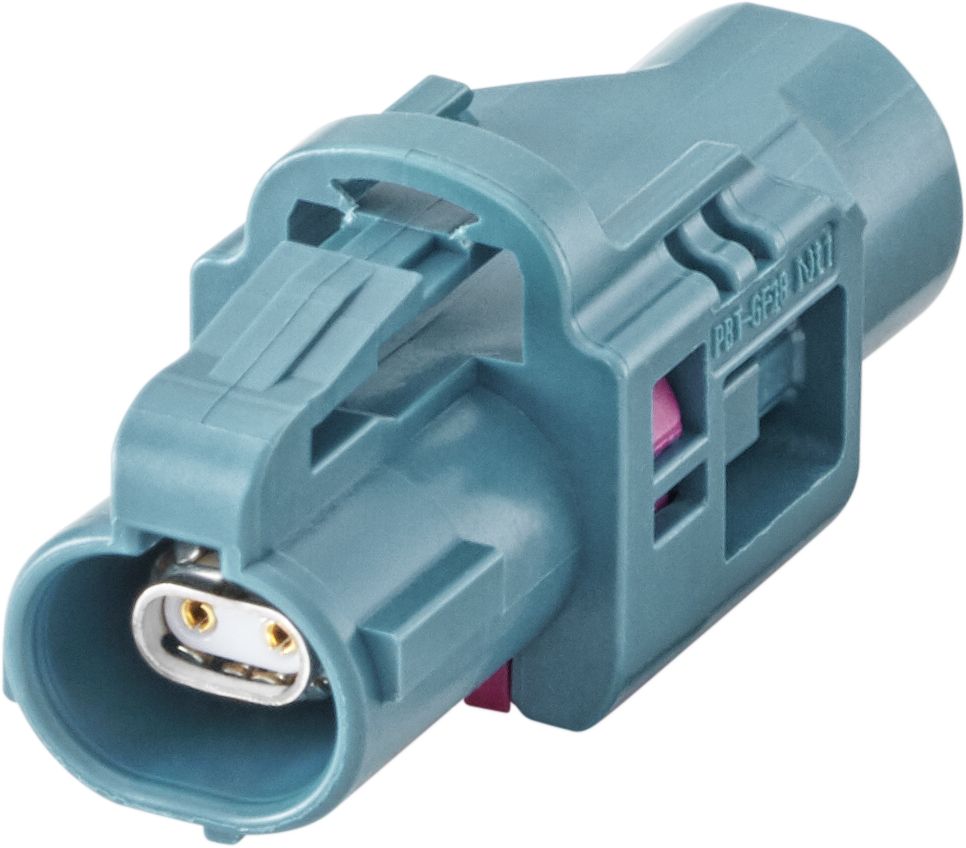
Our RHT-605-20223 is an H-MTD female cable assembly designed for high-speed automotive data connectivity applications. It features a straight, water-blue Z-code connector and a GG 2Speed® 251 cable with a PVC outer jacket.
We offer this assembly as an alternative to Rosenberger part number E6K10A-1CAZ5-Z.
For detailed dimensions and connection information, please refer to our RHT-605-20223 product drawing.

Refer to the official product drawing for dimensional and connection details. Confirm the latest specifications with our team before production approval.
2. What Is an H-MTD Female Cable?
H-MTD, or High-Speed Modular Twisted-Pair Data, is a compact connector system developed for high-speed data connectivity, particularly in automotive applications.
Modern vehicles rely on communication links between cameras, radar sensors, ECUs, domain controllers, and other electronic modules. These links must maintain appropriate electrical performance while accommodating the mechanical constraints of vehicle installations.
An H-MTD cable assembly combines a defined connector interface with a specified cable to provide the physical connection between compatible devices.
Connector Coding
Confirm connector gender, key code, mating geometry, and locking arrangement.
Controlled Impedance
Maintain impedance compatibility across the cable and connector transitions.
High-Frequency Performance
Evaluate return loss, insertion loss, crosstalk, shielding, and EMC requirements.
3. Key Performance Characteristics of Our GG 2Speed 251 H-MTD Cable
3.1 100 Ω Impedance for High-Speed Data Connectivity
Our RHT-605-20223 cable assembly is specified with a nominal impedance of 100 Ω.
Impedance discontinuities at connector transitions, cable interfaces, or PCB routing sections can cause signal reflections. These reflections may reduce signal margins and affect communication reliability, particularly as signal frequencies increase.
A nominal 100 Ω impedance is an important specification, but it does not independently establish the maximum achievable data rate of the complete system.
3.2 Frequency Range and Return Loss
Our RHT-605-20223 is specified for a frequency range of DC to 10 GHz, with the following return loss requirements across the listed frequency bands.
Visual comparison of specified minimum limits, not measured test results.
Return loss describes the amount of signal reflected by impedance discontinuities. Higher return loss in decibels generally indicates less reflected signal.
These specifications help engineers evaluate the assembly for high-frequency applications. Acceptance criteria should be determined by the target communication standard and the requirements of the complete channel.
3.3 Operating Temperature and Mechanical Construction
Our RHT-605-20223 is specified for operation from −40°C to +105°C.
Its listed construction includes a PBT-GF20 housing, a PBT-GF30 secondary lock, bronze contacts, and a PVC cable jacket with a nominal outer diameter of 4.0 mm.
These specifications are relevant when checking the assembly against the temperature, packaging, and routing constraints of an automotive electronics installation. Please refer to our engineering drawing to confirm dimensions, connector orientation, and installation space.
3.4 Cable Configuration and Connection Details
The current RHT-605-20223 drawing specifies a nominal cable length of 2,000 ± 30 mm.
4. Automotive Applications of H-MTD Female Cables
H-MTD cable assemblies can be used in automotive systems where compact, high-speed data connections are required. The appropriate configuration depends on the device interface, communication requirements, and installation environment.

Illustrative automotive application overview. Actual interface requirements depend on the system design.
ADAS Camera Systems
For camera-to-controller connections, verify the mating interface, cable length, and signal-integrity requirements. The RHT-605-20223 can be considered when its specifications match the target system.
Radar and LiDAR
Radar and LiDAR connections require suitable interfaces, cable routing, and environmental performance. Check the assembly’s published specifications against the sensor system requirements before selection.
ECUs and Domain Controllers
Connections between ECUs and domain controllers require the correct interface, pin assignment, and cable length. Refer to the RHT-605-20223 engineering drawing to verify these details before integration.
Automotive Ethernet
Automotive Ethernet compatibility depends on the selected PHY and complete-channel performance, not frequency range alone. Verify the assembly’s return loss and other required electrical parameters against the target channel specifications.
The RHT-605-20223 can be evaluated for automotive data applications that match its published specifications. Contact RENHOTEC to discuss your interface, cable length, and technical requirements.
5. Compatibility with E6K10A-1CAZ5-Z
At RENHOTEC, we offer the RHT-605-20223 as an alternative to Rosenberger part number E6K10A-1CAZ5-Z. For engineering and procurement teams evaluating this alternative, we recommend confirming the mating interface, mechanical dimensions, pin assignment, and electrical requirements before approving the assembly for production use.
What Should Be Verified?
01. Connector part number, gender, and Z-code.
02. Mating geometry, locking arrangement, and mechanical dimensions.
03. Cable configuration, nominal length, and pin assignment.
04. Electrical specifications and environmental requirements.
05. Complete communication-channel performance.
Mechanical mating compatibility and a matching frequency specification do not, by themselves, guarantee a particular data rate. Our product drawing provides the dimensional and connection details needed for an engineering review.
Review the RHT-605-20223 Engineering Drawing →6. How to Select the Right H-MTD Cable Assembly
We recommend the following five-step review before selecting an assembly for your project.
Confirm the Complete Connector Part Number
Identify the device-side connector part number, gender, key code, and mating interface. Check dimensions and the locking arrangement against the approved drawing.
Define the Required Data Rate
Determine the applicable communication PHY and target data rate. Assess the complete channel rather than relying on impedance or frequency range alone.
Select the Appropriate Cable Length
Choose a length that accommodates the installation route. Our current RHT-605-20223 drawing specifies 2,000 ± 30 mm. Confirm availability if another length is required.
Check Electrical and Environmental Requirements
Review impedance, return loss, operating temperature, and mechanical requirements. Obtain supporting evidence for any required IP rating, vibration resistance, chemical resistance, or EMC performance.
Validate the Complete Communication Link
For demanding high-speed applications, validate the assembly with the intended devices and channel configuration. Testing may include return loss, insertion loss, crosstalk, continuity, shielding, and system-level communication performance.
A complete engineering review helps reduce the risk of selecting a mechanically compatible cable that does not meet the electrical requirements of the application.
7. Custom H-MTD Cable Requirements and Technical Support
At RENHOTEC, we understand that automotive electronics projects may require specific cable lengths, connector configurations, and installation arrangements.
To help us evaluate your requirements, please prepare the following information:
- Device-side connector part number and mating-interface drawing
- Required connector gender and coding
- Target cable length and routing constraints
- Applicable communication PHY and target data rate
- Operating temperature and environmental requirements
- Required testing, documentation, and project quantity
Need an H-MTD Cable for Your Automotive Project?
Share your connector part number, cable length, target data rate, and application requirements. Our team can help review the available configuration for your project.
View RHT-605-20223 → Request Technical Support
Connectors & cable assemblies manufacturer.
Sharing insights on connectors and real-world applications.
Contact for datasheets, samples, or inquiries.
