
Project Background
As Smart logistics continues to reshape global supply chains, transitioning robotic fleets from predictable indoor environments to unpredictable, all-terrain scenarios has become the ultimate benchmark for commercial viability. Maintaining 24/7 uptime under these demanding real-world workloads requires absolute hardware resilience—where every internal interconnect, from a high-reliability fakra cable for seamless tracking to rugged data backbones, plays a critical role.
System Architecture
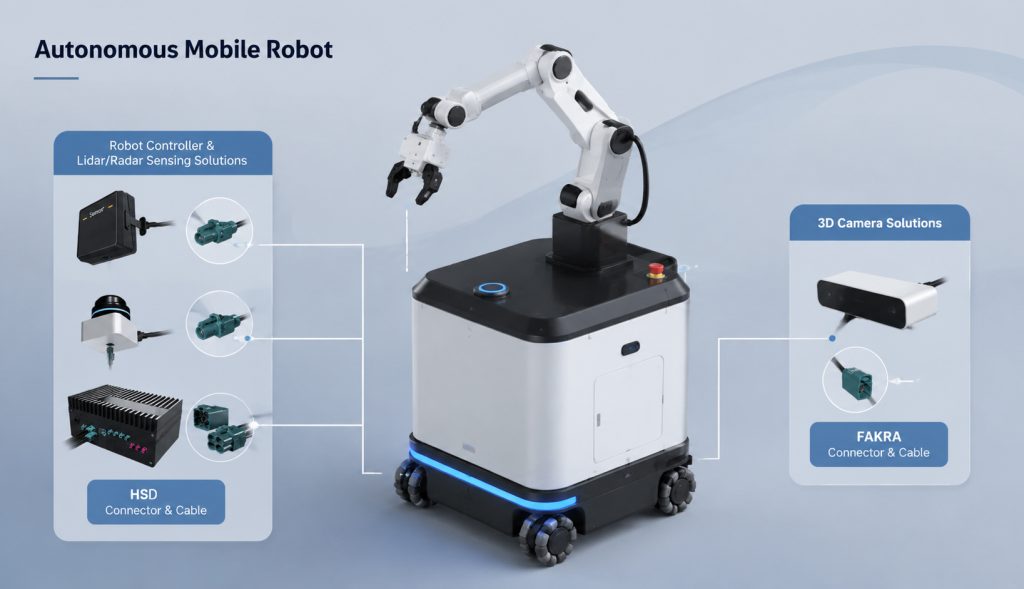
To fully understand how do autonomous mobile robots work under these harsh conditions, one must examine the tightly integrated, three-layer hardware architecture housed within the vehicle’s compact chassis:
- Perception Layer (The Sensors): Equipped with GNSS satellite positioning antennas, 360-degree obstacle-avoidance millimeter-wave radars, and front/rear dual-lens HD surveillance cameras.
- Interaction Layer (The UI): Features a front-facing interactive touchscreen for QR code scanning, parcel retrieval, and real-time operational prompts.
- Control Layer (The Brain): Integrates the central mainboard, a multi-sensor fusion gateway, and drive control modules responsible for physical mobility.
With the rapid scale-up of the client’s global fleet deployments, ensuring instantaneous, zero-loss communication between these three critical layers became the absolute priority for the entire project.
Challenge
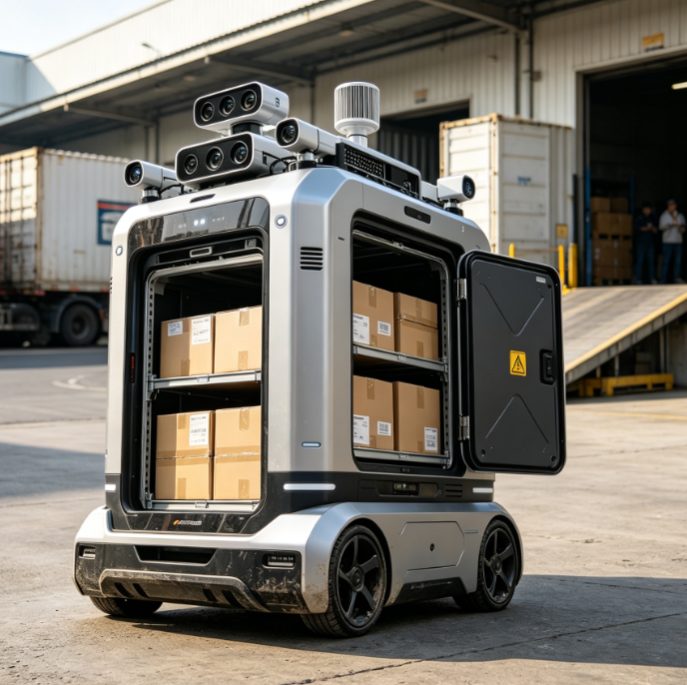
While the automotive industry has long established standards for vehicle electronics, the operating conditions for delivery robots are arguably much more severe. Inside the compact chassis of an AMR, routing space is extremely limited. Furthermore, these robots must endure constant bumps and mechanical shocks as they navigate uneven terrain, all while operating in commercial parks saturated with intense 5G and WiFi electromagnetic interference (EMI). The baseline requirement was a system capable of 24/7 continuous, unattended operation.
Initially, the client equipped their fleets with standard industrial wiring harnesses. However, this deployment quickly demonstrated exactly why standard industrial cables fail in robots. Standard cabling simply could not withstand the rigors of constant, multi-axis motion and heavy signal interference. The client faced a series of high-frequency, critical failures that threatened the project’s viability:
- Severe Navigation Errors: Unstable positioning signals led to significant GPS drift, causing the robots to frequently deviate from their intended paths and even collide with walls. This unpredictability resulted in an unmanageable on-site maintenance workload.
- Vision and Interaction Failures: The amr camera feeds suffered from severe stuttering and video lag, while the interactive touchscreens frequently became unresponsive. This severely degraded the human-machine interaction, frustrating users during the parcel retrieval process.
- Critical Latency: High data interaction delays across the central network made the robots sluggish, completely compromising their ability to detect and evade sudden obstacles in real-time.
Ultimately, these compounding issues—ranging from sudden network disconnections to emergency system halts—drove after-sales repair costs to unsustainable levels. The client urgently needed a comprehensive hardware overhaul utilizing heavy-duty, vibration resistant connectors and shielded cabling to stabilize their data, vision, and RF transmission links.
Solution
To overcome these structural and environmental roadblocks, we provided a comprehensive, one-stop suite of Automotive-Grade Robotic Cable Assemblies. By transitioning from fragile industrial wires to ruggedized, vehicle-grade interconnects, we restructured the robot’s signal, video, and network architecture into a resilient, high-bandwidth ecosystem.
AMR Connectivity Solution Mapping
Automotive-grade interconnect solutions optimized for critical AMR systems.
FAKRA
GNSS Antenna + Radar
Positioning & obstacle detection
FAKRA Cable Assemblies
✓ Stable RF transmission
✓ Reduced GPS drift
✓ EMI protection
✓ Reduced GPS drift
✓ EMI protection
HSD
Camera + Touch Display
HD video & user interaction
LVDS HSD Cable
✓ Real-time video
✓ Low-latency display
✓ Compact routing
✓ Low-latency display
✓ Compact routing
H-MTD
Controller + Gateway
Sensor data communication
H-MTD Connector
✓ High-speed Ethernet
✓ Sensor fusion
✓ Vibration resistance
✓ Sensor fusion
✓ Vibration resistance
The architecture was split into three highly specialized sub-systems:
FAKRA Cable for High-Precision Navigation and Radar Interconnects
The first priority was to stabilize positioning and radar communication. To achieve this, fakra cable assemblies were deployed between the GNSS antenna, millimeter-wave radar modules, and the vehicle control system.
- Space-Saving Design: Compared with conventional RF cables, the selected fakra cable solution offers compact, mechanically keyed connectors with secure locking mechanisms, making installation more reliable within the robot’s limited internal space.
- Advanced Shielding: A dedicated gps fakra connection ensures stable satellite signal transmission, while the fully shielded structure minimizes interference from surrounding 5G and Wi-Fi networks.
- Vibration Resistance: Designed for continuous movement and mechanical vibration, these automotive-grade RF interconnects maintain consistent signal integrity during long-term operation. So navigation stability improved, reducing GPS drift and enabling more accurate route planning across complex operating environments.
High-Speed HSD Cable Solutions for Lossless HD Vision and Displays
The robot’s perception and user interaction systems require continuous transmission of high-definition video and responsive display signals. To support these requirements, the engineering team implemented a fakra hsd connector architecture using LVDS HSD cable assemblies for the front and rear cameras as well as the touchscreen interface.
- Ultra-low Latency Telemetry: The high-speed differential transmission technology delivers stable, low-loss communication between image sensors and the central controller, allowing every amr camera to stream real-time video with minimal latency.
- Power and Signal Integration: The integrated signal-and-power design also simplifies internal routing by reducing the number of individual cable runs inside the chassis.
- High Flexibility: The flexible cable construction allows tight bending without compromising electrical performance, making the solution well suited to compact mobile robotic platforms where installation space is limited.
H-MTD Ethernet Cable Backbone for High-Speed Multi-Sensor Fusion
To connect the robot’s core control network, the engineering team selected the h mtd connector as the backbone of the internal Ethernet architecture.
- Rapid Synchronization: Delivering up to 1 Gbps bandwidth with virtually zero latency , the H-MTD framework unified and synchronized telemetry data from all onboard sensors in milliseconds. This allowed the AMR’s drive system to execute instant evasion and braking commands safely.
- Reliability: Unlike conventional industrial Ethernet connectors that may loosen under continuous vibration, the automotive-grade H-MTD interface is designed to withstand long-term mechanical stress while maintaining stable high-speed communication.
Result & Value
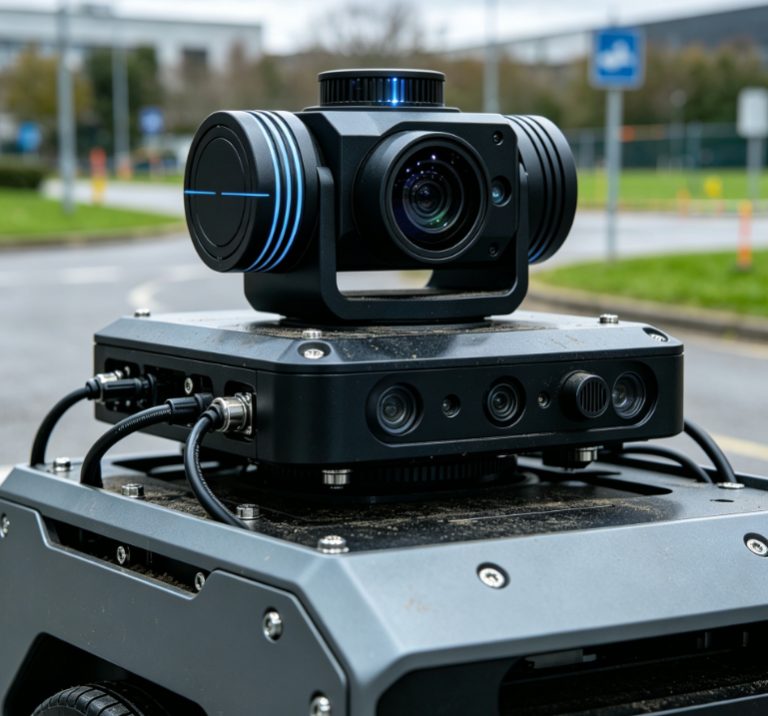
The deployment of these automotive-grade interconnects yielded immediate, quantifiable improvements across the client’s entire fleet, shifting their operational paradigm from reactive troubleshooting to predictable scaling:
90%
Maintenance Cost Reduction
Reliable cable assemblies significantly reduced connector failures, maintenance frequency and replacement costs.
24/7
Continuous Operation
Stable signal transmission enabled uninterrupted AMR operation in demanding smart logistics environments.
GPS Stability
Reduced GPS drift for more accurate navigation and positioning.
HD Video
Stable low-latency camera and display communication.
Ethernet Reliability
Continuous high-speed communication between sensors and controllers.
Faster Assembly
Standardized cable routing simplified manufacturing and maintenance.
Partner with an Expert
Whether you’re developing an Autonomous Mobile Robot, upgrading an agv system, or designing a next-generation Unmanned delivery vehicle, reliable connectivity is essential to long-term performance.
If you’re looking to improve reliability, reduce maintenance costs, or optimize your robot’s internal connectivity architecture, we’re ready to help you identify the right solution for your application.
Talk to Our Engineers | Browse Our Full Interconnect Solutions Catalog

Connectors & cable assemblies manufacturer.
Sharing insights on connectors and real-world applications.
Contact for datasheets, samples, or inquiries.
