
What Is a Glass-to-Metal Sealed Connector?
In high-reliability electronic systems, standard interconnects often fail when exposed to aggressive media, high fluid pressure, or severe environmental vacuum. A glass-to-metal sealed connector is a highly engineered interconnect device designed to transfer electrical power, high-frequency signals, or data across physical barriers while maintaining an absolute pressure-tight barrier. By fusing specialized technical glass directly to metallic pins and outer housing shells, these components eliminate mechanical micro-gaps and prevent continuous fluid leakage or gas diffusion.
Often designated as a hermetically sealed connector, this technology leverages inorganic, non-porous glass as an insulating dielectric medium. Unlike traditional connector designs relying on synthetic rubber gaskets, elastomeric O-rings, or epoxy encapsulants, glass exhibits near-zero permeability to atmospheric gases, moisture, oils, and chemical solvents. Consequently, a glass-to-metal seal provides permanent hermetic protection over multi-decade operational lifetimes, ensuring critical sub-assemblies remain isolated in mission-critical applications spanning aerospace, security, deep-sea exploration, medical technology, and industrial processing.
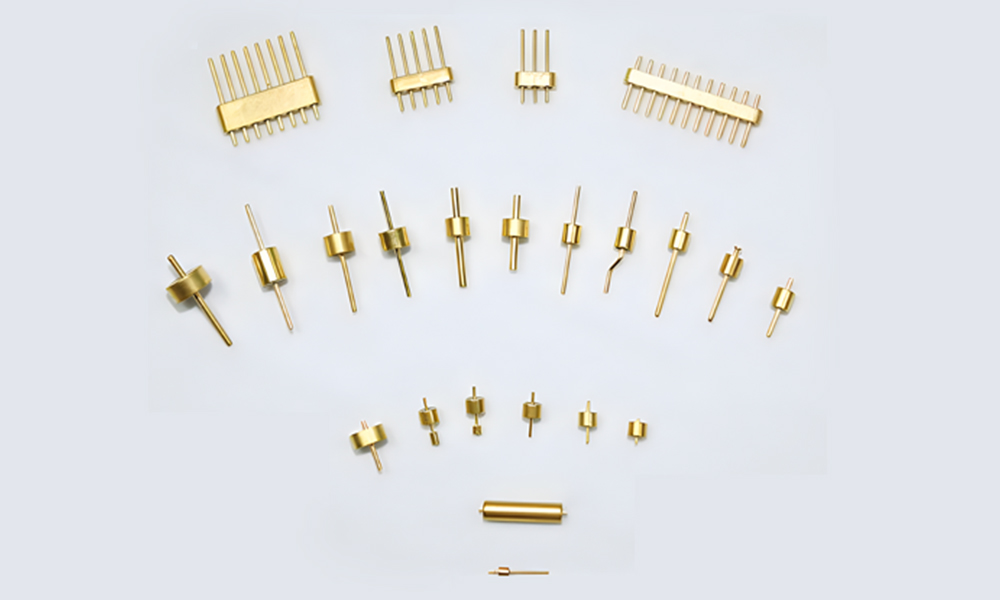
How Does a Glass-to-Metal Connector Work?
Rather than relying on a removable gasket or elastomer as the primary barrier, a glass-to-metal sealed connector creates a hermetic barrier by permanently sealing glass, metal housing, and electrical conductors into a single structure. The glass provides electrical insulation while forming the sealed interface between the internal conductors and the metal housing.
This combination allows glass-to-metal sealed connectors to pass electrical signals through a wall, enclosure, chamber, or pressure boundary while maintaining the required level of environmental isolation.
The exact glass composition, metal materials, dimensions, and sealing design depend on the connector’s operating temperature, pressure, electrical requirements, leak-rate specification, and intended application.
What Are the Main Components?
A typical hermeticity-rated glass-to-metal seal assembly comprises three primary structural components, each engineered to fulfill rigorous mechanical and electrical parameters:
Insulating Glass Core: The glass preform serves as the dielectric isolation medium separating the contacts from each other and the outer shell. Formulations vary from standard soda-lime glass to specialized borosilicate glass and high-purity glass-ceramics, chosen specifically for dielectric strength, thermal shock resistance, and CTE compatibility.
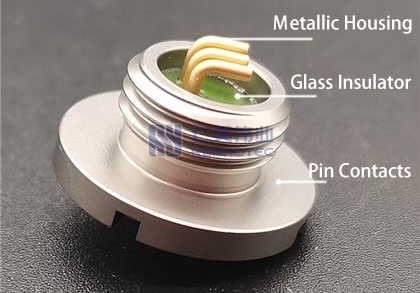
Metallic Housing / Shell: The outer body provides mechanical mounting features (such as threads, weld flanges, or press-fit profiles) and structural rigidity. Common shell alloys include 304L/316L stainless steel, Kovar, Inconel, cold-rolled steel, and Titanium. When continuous wall mounting is required across pressure vessels, the housing is engineered as a robust hermetic bulkhead interface.
Conductive Contacts / Pins: The central conductor pins transport electrical current or high-frequency signals through the hermetic barrier. Depending on CTE match requirements and conductivity parameters, pin materials include Kovar, Alloy 52, Nickel-Iron alloys, Beryllium Copper, and Molybdenum. Contacts are frequently plated with nickel and gold to optimize solderability, corrosion resistance, and wire-bonding performance.
Types of Glass-to-Metal Seals and Hermetic Components
1. Hermetically Sealed Connectors
Primary interconnect structures engineered for removable electrical coupling in high-stress operational environments:
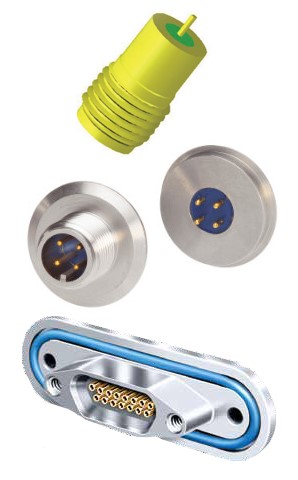
- Circular Hermetic Connectors: Built around industry-standard circular frameworks such as MIL-DTL-38999, MIL-DTL-26482, and industrial M12/M8 formats. Incorporating a hermetic circular connector ensures seamless integration with standard cable harnesses while providing robust pin retention and high pin-density isolated configurations.
- RF / Coaxial Hermetic Connectors: High-frequency microwave interconnects including SMA, BNC, Type N, 2.92mm, 2.4mm, and SMP/SMPM interface profiles. These assemblies maintain precise 50-ohm characteristic impedance matching alongside hermetic glass isolation, essential for radar, telecommunications, and high-speed test instrumentation.
- D-Sub & Micro-D Hermetic Connectors: High-density rectangular connectors tailored for space-constrained rack-and-panel equipment, avionics boxes, and aerospace electronics where multi-pin arrangements must pass through sealed enclosure walls.
2. Hermetic Feedthroughs
Feedthrough components facilitate permanent, uninterrupted electrical pass-through across structural walls and pressure barriers:
- Glass-to-Metal Seal (GTMS) Feedthroughs: Rigid pin-type feedthroughs use glass-to-metal sealing to pass electrical conductors through sealed walls, pressure boundaries, or vacuum chambers while maintaining hermeticity.
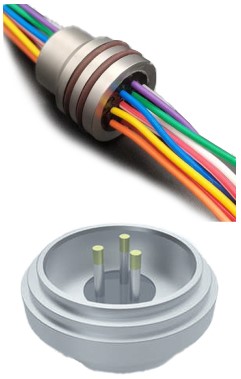
- Wire Harness / Pigtail Feedthroughs: These feedthroughs integrate the sealing structure with pre-attached wires or cable assemblies, providing a direct electrical connection for sealed sensors, pumps, motors, and other equipment.
3. Hermetic Headers and Terminals
Base plates and power connection assemblies designed for discrete component encapsulation:
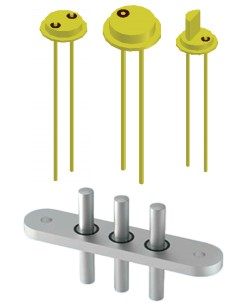
- TO-Headers: Specialized transistor outline headers (e.g., TO-46, TO-56) featuring precise multi-pin glass feedthroughs. Used widely as structural mounting bases for laser diodes, optical receivers, photodetectors, and gas sensors.
- Compressor and Battery Hermetic Terminals: Heavy-duty single-pin or multi-pin high-current terminal seals engineered for HVAC compressors, industrial refrigeration units, and new-energy vehicle (NEV) lithium battery cover plates. These terminals prevent refrigerant and liquid electrolyte leakage under continuous pressure and vibratory stress.
4. Hermetic Packages / Housings
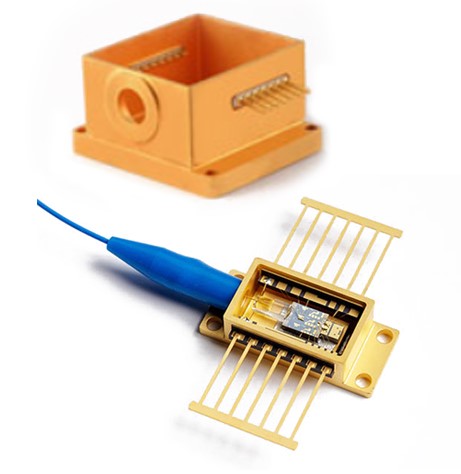
Hermetic packages and housings use glass-to-metal sealing or other hermetic sealing structures to protect sensitive electronic and optoelectronic components from moisture, gases, and other environmental contaminants.
- RF / microwave packages
- Optical / optoelectronic packages
- Butterfly packages
- Sensor housings
Applications of Glass-to-Metal Seals and Hermetic Connectors
Glass-to-Metal Seal technology is foundational across industries where hardware failure caused by atmospheric exposure or fluid ingress is strictly intolerable.
- Aerospace & Security: Avionics enclosures, radar modules.
- Oil & Gas Exploration: Downhole logging tools, subsea wellhead control pods, offshore equipment.
- Medical Equipment: Implantable pacemakers, defibrillators, surgical tools, diagnostic equipment.
- Automotive & EV: Airbag inflator initiators, EV battery cover terminals, pressure sensors.
- Vacuum & Semiconductor Equipment
- Sensors & Instrumentation
Explore our glass-to-metal sealing customization capabilities for aerospace, automotive, semiconductor, sensor, and other high-reliability applications.
Request Custom SolutionGlass-to-Metal Sealed Connector vs Standard Connector
Understanding the fundamental performance differences between GTMS interconnects and standard industrial connectors is vital for correct hardware selection:
| Performance Metric | Standard Connector (Epoxy / O-Ring) | Glass-to-Metal Sealed Connector |
|---|---|---|
| Hermeticity Level | Moderate (10-3 to 10-6 mbar · L/s air) | Ultra-High (≤ 1×10⁻⁹ atm cc/s Helium) |
| Operating Temperature | Restricted (-40°C to +125°C due to polymer degradation) | Extreme (-200°C cryogenic to +500°C+) |
| Pressure Resistance | Low to Moderate (< 500 PSI) | Extreme (> 10,000 to 20,000 PSI) |
| Chemical Resistance | Prone to swelling, aging, and chemical degradation | Completely impervious to solvents, fuels, and acids |
| Operating Lifespan | Degrades over time due to elastomer oxidation and set | Virtually unlimited operational life (30+ years) |
How to Choose a Reliable Glass-to-Metal Seal Manufacturer
Designing and manufacturing GTMS components requires complex metallurgical, ceramic, and thermal processing expertise. Selecting an established hermetic connector supplier involves evaluating several core technical capabilities:
- Custom Engineering & DFM Capability: Leading hermetic connector manufacturers must possess strong Design for Manufacturability (DFM) capabilities, offering localized thermal FEA modeling, CAD simulation, and customized contact pin layouts tailored to client envelope constraints.
- Materials & Glass Formulation Expertise: A qualified hermetic glass seal manufacturer should maintain deep expertise in selecting and processing specialized glass frits (borosilicate, soda-barium, or glass-ceramic) alongside compatible housing metals (Kovar, Stainless Steel 316L, Inconel, Titanium).
- Hermeticity & Quality Testing: Ensure the facility is fully equipped with advanced quality assurance infrastructure, including Helium Mass Spectrometer Leak Detectors (capable of verifying leakage rates below 1×10⁻⁹ atm cc/s He, hydrostatic high-pressure test chambers, dielectrical breakdown testers, and optical pin positioning systems.
- Prototype & Production Capability: The vendor must seamlessly scale operations from low-volume quick-turn prototyping to high-yield automated mass production without compromising hermetic integrity or pin alignment tolerances.
- Application Experience: Experience with demanding applications can also be an important selection criterion. A manufacturer’s experience in areas such as aerospace, automotive, RF and microwave, vacuum equipment, sensors, or energy systems can help reduce design risk and shorten the development process.
Want to See a Real-World GTMS Case Study?
Explore how Renhotec develops custom glass-to-metal sealing solutions for demanding applications.
How to Specify a Custom Glass-to-Metal Seal
To accelerate custom development and avoid design iterations, engineers should define clear design parameters across three primary categories when submitting technical specifications:
Electrical Requirements
Specify the electrical requirements of the application, including:
- Operating voltage
- Dielectric withstand voltage
- Current rating
- Number of contacts
- Insulation resistance
For RF or high-speed applications, also provide the required impedance, operating frequency, insertion loss, and return loss/VSWR.
Mechanical Requirements
- Mounting & Interface Style: Select appropriate body mounting methods, such as laser welding flange, thread-in, press-fit, or double-ended hermetic bulkhead configurations.
- Dimensional Constraints: Provide housing envelope limits, total pin counts, pitch dimensions, and terminal termination types (solder cups, PCB eyelets, wire-wrap, or crimp pins).
- Mating Interface Compatibility: Verify compliance with standard coupling frameworks, such as circular hermetic connectors or precision RF interfaces.
Environmental Requirements
- Pressure Differential: State working pressure and maximum proof/burst pressure levels, indicating whether pressure is applied from the front or rear face of the seal.
- Thermal Range & Thermal Shock: Detail minimum/maximum operating and storage temperatures, along with required thermal shock ramp rates.
- Media Compatibility & Corrosion Resistance: Identify environmental media exposure (e.g., hydraulic fluid, aviation fuel, salt spray, sour gas H2S, or high-vacuum environments).
Need Tailored Hermetic Solutions?
Request Technical Consultation
Explore our comprehensive design capabilities and request technical consultation directly on our Custom Glass-to-Metal Seal Solutions page to accelerate your product development cycle.
FAQ
Q1: What is the maximum leak rate allowed for a true hermetic glass seal?
A standard industry threshold for true hermeticity is a leak rate not exceeding 1×10⁻⁸ atm cc/s of Helium (or 1×10⁻⁹ mbar·L/s). High-reliability military and aerospace glass-to-metal connectors often achieve leak rates superior to 1×10⁻¹⁰ mbar·L/s He.
Q2: Can glass-to-metal seals handle cryogenic or extremely high temperatures?
Yes. Matched glass-to-metal seals utilizing Kovar and specialized borosilicate glass perform reliably at cryogenic temperatures near -200°C. High-temperature ceramic and glass formulations can continuously withstand operating environments exceeding +400°C to +500°C without mechanical failure or loss of vacuum integrity.
Q3: Why is Helium used for hermetic leak testing?
Helium features small atomic dimensions, light molecular weight, inert chemical safety, and minimal natural atmospheric background concentration. These properties allow Helium Mass Spectrometer Leak Detectors to rapidly detect microscopic leak paths through sintered glass or metal joints that larger air or water molecules could not traverse during short test windows.
Q4: Are glass-to-metal connectors compatible with standard mating cables?
Yes. Most circular hermetic connectors and coaxial GTMS interfaces are manufactured to strict industry interface specifications (such as MIL-DTL-38999, M12, SMA, or BNC), making them 100% intermateable with standard commercial or military cable plugs while providing hermetic containment on the receptacle side.
Contact US
From hermetic connectors and feedthroughs to custom glass-to-metal sealed components, we provide solutions designed around your specific electrical, mechanical, and environmental requirements.

As an industry specialist at Renhotec Group, I have years of expertise in the field of electronic interconnection. Founded in 2008, Renhotec Group is a global leader in designing and manufacturing connectors, cables, and custom electronic components for a wide range of industries. We are committed to providing high-performance interconnect solutions, leveraging technical innovation and rigorous quality standards to empower global customers across industrial, RF, and EV sectors.
