
Introduction
The evolution of Advanced Driver Assistance Systems (ADAS) and high-resolution in-vehicle displays has driven an exponential demand for high-speed data transmission within modern vehicle architectures. To meet these massive bandwidth requirements, Gigabit Multimedia Serial Link (GMSL) technology has emerged as a premier High-Speed Serializer/Deserializer (SerDes) protocol. Over the years, the industry has transitioned through GMSL1, GMSL2, and the latest GMSL3 platforms to support increasingly sophisticated sensing and display networks.
However, designing a robust communications link requires more than just selecting high-performance SerDes silicon. A highly reliable transmission channel depends heavily on the entire physical layer architecture. This encompasses the precise selection of a high-quality gmsl cable, utilizing either 50Ω single-ended coaxial cables or 100Ω shielded twisted pair (STP) wiring. Furthermore, the integrity of the data stream relies on the precise engineering of the Automotive Camera Connector, the design of the printed circuit board (PCB) traces, and the implementation of appropriate termination networks. Whether routing data from a surround-view GMSL camera to an Electronic Control Unit (ECU) or distributing high-definition video to a central dashboard display, understanding the intricacies of the physical interconnect is fundamental to ensuring long-term system stability and signal integrity in harsh automotive environments.
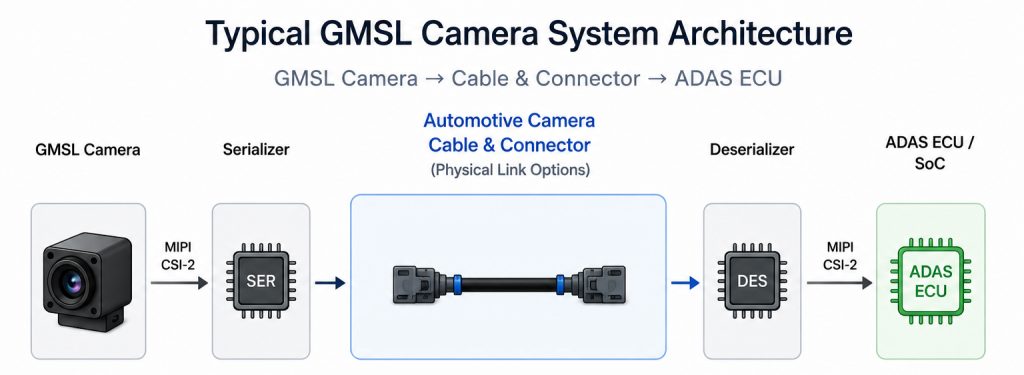
GMSL1 vs GMSL2 vs GMSL3: Data Rate, Cable Type and Connector Requirements
As automotive vision systems transition from basic 720p rearview monitoring to complex 4K multi-sensor ADAS arrays, the underlying SerDes protocols have scaled accordingly. Each generation of the GMSL standard introduces stricter requirements for the physical channel, directly influencing the type of gmsl cable required to maintain signal integrity over vehicle-length runs.
The following table outlines the core technical parameters, physical interfaces, and typical applications across the three primary GMSL generations:
| Technical Parameter | GMSL1 | GMSL2 | GMSL3 |
|---|---|---|---|
| Release Year | 2003-2004 | 2015-2017 | About 2020 |
| Lifecycle Status | Legacy (Phased Out) | Current Mainstream | Future-Proof Trend |
| Max Forward Data Rate | Up to 3.12 Gbps | Up to 6 Gbps | Up to 12 Gbps |
| Back Channel Rate | 1 Mbps or 187.5 Kbps | Up to 187.5 Mbps | Up to 187.5 Mbps |
| Signal Modulation | NRZ | NRZ | PAM4 |
| Primary Cable Type | Coaxial (50Ω) or STP (100Ω) | Coaxial (50Ω) or STP (100Ω) | High-performance Coaxial (50Ω) |
| Typical Connector | Standard FAKRA, HSD | Standard FAKRA, HSD | Mini-FAKRA (HFM / MATE-AX) |
| Typical Application | Basic rearview cameras, standard infotainment screens | Surround-view systems, autonomous vision, multi-display | 4K ADAS vision systems, LiDAR/RADAR data aggregation |
Balancing Bandwidth, Complexity, and Cost
Choosing the right GMSL generation is a critical architectural decision that hinges on balancing bandwidth demands, system complexity, and overall cost:
- GMSL1 is now largely restricted to legacy, highly cost-sensitive projects requiring minimal bandwidth. It is generally not recommended for new product designs.
- GMSL2 serves as the optimal choice for mainstream applications utilizing 1080p or 4K@30fps video streams. It offers a highly mature, stable ecosystem that simplifies wiring harnesses through reliable Power over Coax (PoC) delivery.
- GMSL3 is the necessary baseline for high-end ADAS platforms that demand 4K@60fps resolutions, uncompressed raw data transmission, or multi-camera fusion where several high-definition feeds must connect to a single central ECU.
Pro Design Tip: To protect your hardware investment, GMSL platforms feature excellent backward compatibility, and many SerDes chipsets are hardware pin-compatible. This allows engineering teams to design a base platform utilizing GMSL2 today, with a clear and seamless migration path to upgrade the physical channel to GMSL3 in the future as system bandwidth requirements scale.
FAKRA Cable Assemblies for GMSL2 Links
When configuring networks for the widely adopted GMSL2 standard, engineers consistently seek the most cost-effective and space-efficient physical layouts. For most standard ADAS implementations, utilizing a single-core coaxial fakra cable assembly has proven to be an exceptionally pragmatic and highly functional solution.
The primary advantage of routing a gmsl cable via a standard coaxial line is the seamless integration of Power over Coax (PoC). PoC allows the same single conductor to carry high-speed video data, bidirectional control signals, and DC power simultaneously. This significantly reduces the overall wiring harness weight, which is a critical design metric for automotive OEMs looking to improve vehicle efficiency. A properly manufactured fakra cable assembly ensures a consistent 50Ω impedance path, minimizing signal reflection and return loss.
Key Selection: FAKRA Code C (Signal Blue)
To prevent mis-mating on complex automotive assembly lines where multiple visual sensors are installed, the FAKRA Connector utilizes specialized mechanical keying and color-coding. For GMSL high-speed video applications, design engineers typically specify FAKRA Code C (Signal Blue). Under automotive RF standardization, Code C is designated for camera systems and GPS links, ensuring that your high-speed GMSL2 lines remain securely locked and strictly isolated from other RF signals (such as AM/FM or keyless entry).
For a typical 8-megapixel GMSL camera transmitting at 6 Gbps, a well-shielded coaxial cable terminated with precise, Code C FAKRA hardware offers an optimal balance of structural ruggedness, low insertion loss, and economic viability.
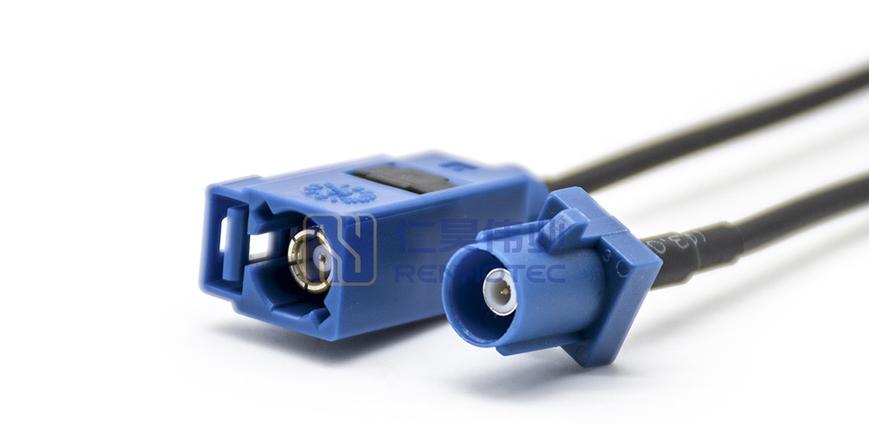
Recommended Connectivity Solutions:
When to Use HSD Connectors in GMSL Architectures
While single-core coaxial lines are the industry standard for cameras, High-Speed Data (HSD) interfaces play a distinct and vital role in automotive SerDes architectures. A standard Automotive Camera Connector based on HSD utilizes a 4-pin shielded differential design, typically paired with 100Ω Shielded Twisted Pair (STP) or Star Quad cables.
Engineers generally specify HSD interconnects when the application demands superior Electromagnetic Interference (EMI) and Electromagnetic Compatibility (EMC) performance. Differential signaling inherently rejects common-mode noise, making HSD solutions highly resilient in environments polluted by high-power electric motors, inverters, and wireless transmitters. Consequently, while coaxial lines excel in compact camera modules, HSD is frequently chosen for routing data from an ADAS control unit to high-resolution dashboard displays, or when bridging critical data hubs through densely packed, electrically noisy sections of the vehicle chassis. Choosing an HSD-based Automotive Camera Connector ensures that high-speed signaling remains robust even when subjected to severe external electromagnetic fields.
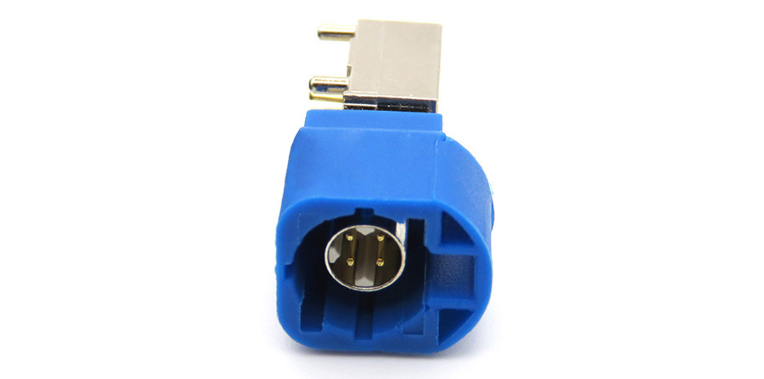
Recommended HSD Connectivity Solutions:
GMSL3: Moving Towards Mini-FAKRA (HFM) Solutions
As the automotive industry scales toward autonomous driving levels requiring uncompressed 4K video streams and instantaneous sensor fusion, the physical layer must adapt to the 12 Gbps threshold of the GMSL3 protocol. At these elevated frequencies, traditional interconnects become a bottleneck due to their physical size and high-frequency signal degradation. Consequently, next-generation architectures are heavily adopting the mini fakra standard as the baseline Automotive Camera Connector to ensure uncompromised data integrity along the gmsl cable.
The term mini fakra encompasses specialized high-frequency miniature interconnects developed by leading automotive hardware suppliers. When evaluating these components, engineers must recognize the distinct brand parameters and specifications of the two leading architectures:
- HFM (High-Speed FAKRA Mini) by Rosenberger: The HFM system is engineered to handle massive data loads, supporting frequencies up to 20 GHz and data transmission rates up to 28 Gbps. It offers up to an 80% reduction in spatial volume compared to legacy FAKRA connectors. This allows engineers to place multi-port headers on highly congested ADAS ECUs without sacrificing critical PCB real estate.
- MATE-AX by TE Connectivity: The MATE-AX portfolio provides a highly dense, miniaturized solution optimized for both standard and high-frequency environments. Standard MATE-AX solutions are rated up to 9 GHz, while optimized variants push the threshold up to 15 GHz, supporting data rates up to 24 Gbps. MATE-AX is specifically designed to minimize cross-talk in multi-port configurations and offers excellent robustness against severe automotive vibrations.
By integrating these specialized miniature interconnects, designers can successfully harness the full bandwidth of GMSL3 while simultaneously reducing the mass and footprint of the wiring harness.
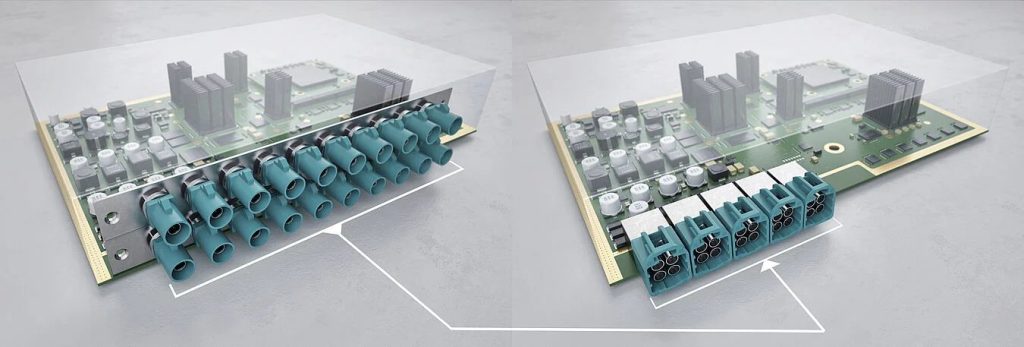
Recommended High-Frequency Solutions:
GMSL vs. Automotive Ethernet
A frequent point of discussion among system architects is whether Automotive Ethernet will ultimately replace SerDes technologies like GMSL, or if the two are meant to coexist. It is crucial to understand that an Automotive Camera Connector designed for GMSL serves a fundamentally different system topology than one designed for a networked Ethernet backbone.
| Feature/Metric | GMSL (SerDes) | Automotive Ethernet (e.g., 1000BASE-T1) |
|---|---|---|
| Topology | Point-to-Point (Asymmetric) | Networked / Switched (Symmetric) |
| Latency | Ultra-low (Microseconds) | Low to Moderate (Milliseconds, depending on switches) |
| Video Compression | Uncompressed (Raw Video) | Typically Compressed (H.264/H.265) |
| Power Delivery | Power over Coax (PoC) | Power over Data Line (PoDL) |
| Primary Use Case | ADAS Cameras, High-Res Displays | Domain Controller networking, OTA updates, LiDAR data |
GMSL and Automotive Ethernet are fundamentally complementary. Automotive Ethernet is ideal for creating the central nervous system of the vehicle, passing processed data, control signals, and networking multiple domain controllers. GMSL, on the other hand, is optimized for massive, unidirectional, zero-delay data pipelines—such as feeding raw pixel data from a front-facing vision sensor directly into a machine learning processor. An optimal automotive architecture utilizes SerDes for edge-sensor raw data acquisition and Ethernet for inter-ECU communication.
Explore Our Automotive Connectivity Portfolio:
How to Choose the Right Connector for Your ADAS Camera
Selecting the optimal Automotive Camera Connector requires a structured evaluation of bandwidth, environmental constraints, mechanical volume, and cost. The selection process typically follows these core evaluation steps:
Step 1: Determine the Protocol and Bandwidth Requirement
Identify whether the system utilizes GMSL1, GMSL2, or GMSL3. Bandwidth directly limits connector choice; a 12 Gbps link will strictly eliminate older, lower-frequency hardware.
Step 2: Evaluate Environmental and EMI Conditions
Assess the routing path of the harness. If the harness passes near high-voltage EV battery lines or inverters, the differential signaling of an HSD connector may be necessary to maintain signal integrity, despite the higher cost compared to coaxial lines.
Step 3: Consider Size and Weight Constraints
If the central ADAS compute unit requires inputs from 8 to 12 surrounding sensors, standard interconnects will consume too much PCB edge space. Miniature multi-port connectors become mandatory.
Decision Table: Project Requirement vs. Recommended Solution
| If your project requires… | Recommended Solution |
|---|---|
| Rear Camera | FAKRA Cable Assembly |
| Multi-camera ADAS | Mini FAKRA |
| Infotainment Display | HSD |
| Long-distance Camera | FAKRA |
| High-density ECU | Mini FAKRA |
| Zonal Network | Automotive Ethernet |
FAQ
Which Connector Is Used with MAX96792A-Based GMSL Systems? ▼
The MAX96792A is a high-performance GMSL3 serializer designed to drive high-bandwidth video data at rates up to 12 Gbps over coaxial or STP media. Because it operates within the stringent high-frequency requirements of the GMSL3 protocol, legacy connectors often exhibit excessive return loss at these speeds. Therefore, it is highly recommended to pair MAX96792A-based hardware with high-frequency Mini-FAKRA solutions, such as Rosenberger HFM or TE MATE-AX, to ensure reliable transmission and adequate signal headroom.
Can I use a standard FAKRA cable assembly for GMSL3 links? ▼
In most professional automotive applications, using a legacy FAKRA setup for GMSL3 is strongly discouraged. Standard FAKRA connectors are generally rated for frequencies up to 3 GHz or 6 GHz, which accommodates GMSL1 and GMSL2 efficiently. However, GMSL3 requires transmission channels capable of handling significantly higher frequencies to support its 12 Gbps data rate. Attempting to push a GMSL3 signal through standard FAKRA hardware will likely result in severe insertion loss, signal degradation, and unacceptably high bit-error rates. Upgrading to a specialized miniature high-frequency connector is the standard engineering practice for GMSL3.
What is the difference between FAKRA and HSD in GMSL applications? ▼
The primary difference lies in their physical construction and signaling methods. FAKRA relies on a single-core, 50Ω coaxial cable using single-ended signaling, which makes it highly space-efficient, cost-effective, and highly suitable for Power over Coax (PoC) delivery to remote sensors. HSD (High-Speed Data) utilizes a 4-pin design with 100Ω Shielded Twisted Pair (STP) or Star Quad cabling, employing differential signaling. This differential architecture provides superior immunity to electromagnetic interference (EMI), making HSD highly effective in electrically noisy environments or for critical interior display links, though it generally requires a larger footprint and higher cost than a single coaxial solution.
Contact Us
Designing a reliable, high-speed physical layer for next-generation ADAS architectures requires deep technical expertise and high-quality components. Whether you are scaling up to GMSL3 or optimizing an existing GMSL2 network, partnering with an experienced FAKRA connector manufacturer ensures that your wire harnesses meet stringent automotive standards for signal integrity, mechanical robustness, and EMI shielding.
Our engineering team specializes in custom high-speed cable assemblies, tailored impedance-matched interconnects, and comprehensive signal integrity testing. Reach out to our technical support staff today to discuss your specific vehicle architecture requirements, request detailed datasheets, or order precision-engineered interconnect samples for your next ADAS prototype.
Email: [email protected]

Connectors & cable assemblies manufacturer.
Sharing insights on connectors and real-world applications.
Contact for datasheets, samples, or inquiries.
