
When selecting RF connectors for your electronic projects, understanding the differences between SMA (Subminiature version A) and SMB (Subminiature version B) connectors is essential. Both connectors are widely used in RF and microwave applications, but they serve different purposes based on their design, performance, and durability.
This comprehensive guide breaks down the core technical differences between SMA and SMB connectors, provides a clear application matrix, and presents a step-by-step engineering selection guide to help you choose the right component for your design.
SMA vs SMB Connector: Quick Comparison
| Feature | SMA Connector | SMB Connector |
|---|---|---|
| Coupling Mechanism | Threaded / Screw-on (1/4″ hex nut) | Snap-on / Push-fit |
| Impedance | 50 Ω (Standard) | 50 Ω and 75 Ω |
| Frequency Range | DC to 6 GHz (Standard); up to 18 GHz+ | DC to 4 GHz – 6 GHz |
| Size & Density | Medium / Compact (Wrench clearance needed) | Subminiature / High-density layout |
| Durability | High (Suited for harsh/high-vibration) | Moderate (Designed for fast mating) |
| Connection Speed | Slow (Requires hand/torque wrench) | Fast (Toolless push-on / pull-off) |
| Primary Applications | RF modules, antennas, test equipment, aerospace | Telecom, automotive electronics, GPS, internal boards |

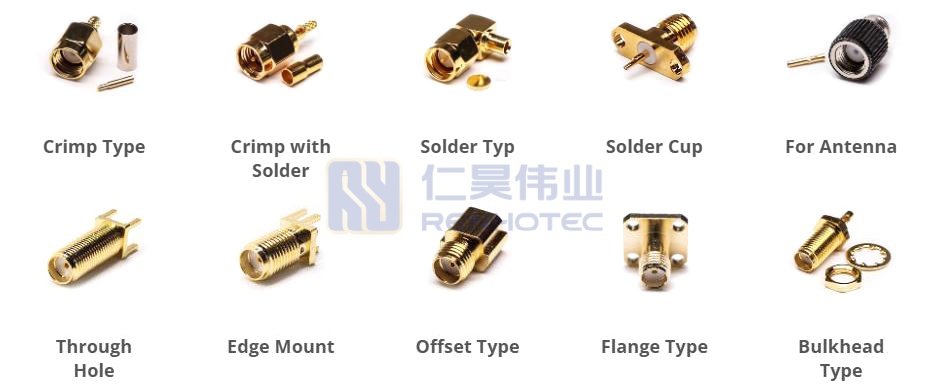
What Is an SMA Connector?
The SMA connector is a threaded, high-performance RF connector recognized for its secure connections and outstanding durability. It is widely preferred for applications requiring stable performance in demanding environments.
- Standard SMA: 50 Ω, screw-on connector used in general RF setups.
- Reverse Polarity SMA (RP-SMA): Universally used in Wi-Fi routers, consumer wireless devices, and drones.
- SMA Right-Angle: Space-saving 90° orientation for tight vertical clearances.
- SMA Edge Mount: Surface/edge-soldered directly onto PCB edges for high-frequency signal routing.
- SMA Bulkhead Mount: Features an O-ring or lock washer for mounting through enclosures or panel cutouts.
- High-Frequency Precision SMA: Specialized variants operating past 18 GHz for microwave test instrumentation.

What Is an SMB Connector?
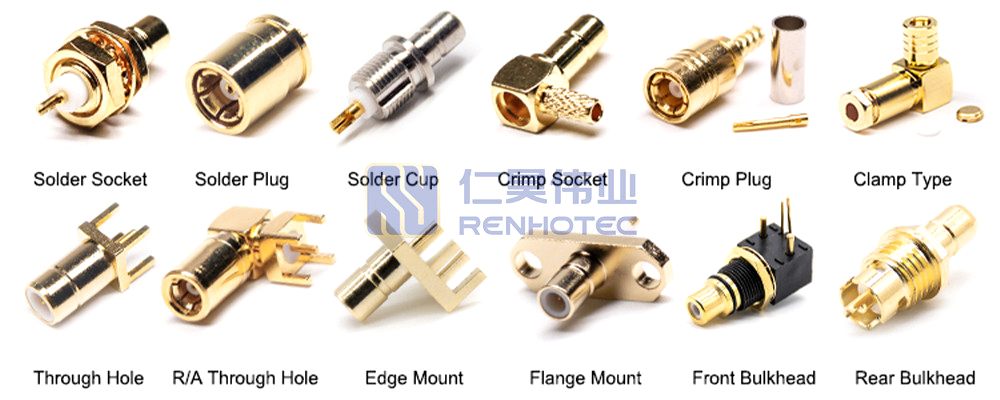
The SMB connector connector was developed as a smaller, faster-coupling alternative to the SMA connector. It replaces the threaded outer shell with a spring-loaded snap-on mechanism, allowing quick connection and disconnection without tools.
- Standard SMB (50 Ω & 75 Ω): Snap-on connectors for internal wiring.
- SMB Right-Angle: Compact, low-profile designs for tight vertical space enclosures.
- SMB PCB Mount (Straight & Edge): Compact board-to-board and board-to-cable interfaces.
- SMB Bulkhead: Panel-mount options for internal enclosure connections.
Key Differences Between SMA and SMB Connectors
Understanding why SMA and SMB connectors differ—and what those differences mean engineered into a circuit—is key to optimizing performance.
Why are these connectors different?
The fundamental distinction lies in their coupling mechanism and dimensional profile.
- SMA relies on threaded engagement (1/4” hex nut thread), which mechanically forces the outer conductors tightly together.
- SMB uses a spring-clip snap-on interface that latches into place with a simple push.
What do these differences mean in engineering terms?
- Frequency & Insertion Loss
Threaded SMA connectors maintain tighter, continuous outer conductor contact, minimizing RF leakage and standing waves (VSWR) up to 18 GHz. SMB connectors have minor mechanical play in their snap mechanism, which limits their stable operation to ~4–6 GHz.
- Vibration Resistance
Under heavy shock or continuous vibration (e.g., aerospace or industrial machinery), an SMB connector can momentarily disconnect or suffer signal modulation. An SMA connector clamped with a calibrated torque wrench remains locked.
- Assembly Efficiency
Torqueing an SMA connector requires space and time. SMB connectors snap together in seconds, drastically reducing assembly time during mass production or field repairs in tight spaces.
- Impedance
SMA is almost exclusively 50 Ω. SMB offers standard 75 Ω variants, making it adaptable for video broadcasting and legacy telecom equipment.
- Cost & Economic Considerations (Unit Cost vs. Total Assembly Cost)
Unit Component Cost: Standard SMB connectors often carry a slightly lower unit price compared to precision SMA connectors, as SMA requires high-precision threaded machining to maintain strict RF performance.
System Assembly & Labor Cost: SMB connectors significantly reduce total production line costs in high-volume manufacturing. The toolless snap-on interface enables rapid mating in seconds without requiring calibrated torque wrenches, saving labor hours compared to installing SMA connectors.
SMA vs SMB: Application Comparison
How do these technical differences manifest in actual systems? Use the matrix below to match connector types to specific application scenarios:
| Application Field | Preferred Connector | Engineering Reason |
|---|---|---|
| Aerospace & Radars | SMA | Requires high vibration resistance and high-frequency microwave band capability. |
| Wi-Fi Routers & Wireless APs | RP-SMA / SMA | Industry standard for detachable external antennas. |
| Automotive Infotainment & GPS | SMB | Compact size and fast assembly on production lines; adequate frequency coverage. |
| RF Test Equipment & Measurement | SMA | Superior VSWR, low insertion loss, and high repeatability up to 18 GHz+. |
| Telecom Base Stations (Internal) | SMB | High packing density on PCBs; quick replacement during maintenance. |
| Consumer Electronics & Video | SMB (75 Ω) | Space-saving form factor with native 75 Ω impedance options. |
How to Choose Between SMA and SMB Connectors
Follow this 6-step engineering decision workflow to determine the exact connector required for your system:
1. Define the Frequency Requirement
- If your application operates above 6 GHz (e.g., 8–18 GHz radar, Ku-band satellite, high-speed test systems), SMA is mandatory.
- If your operating frequency is below 4–6 GHz, both SMA and SMB are viable options.
2. Evaluate the Mechanical Environment
- High vibration, extreme shock, or harsh outdoor deployment requires the locked security of a threaded SMA connector.
- Stationary, well-protected internal enclosures permit the use of SMB connectors.
3. Check Available Installation Space
- SMB requires significantly less board space and no extra clearance around the coupling nut.
- SMA requires enough room around the connector interface for fingers or a torque wrench to tighten the 1/4” hex nut.
4. Consider Mating Frequency
How often will this connection be plugged and unplugged?
- For rapid testing, internal modular swapping, or fast production assembly, the snap-on SMB saves significant time.
- For semi-permanent connections that must not loosen over time, choose SMA.
5. Confirm Impedance
- RF microwave systems standardizing on 50 Ω can use either.
- Video transmission or telecommunications infrastructure requiring 75 Ω must use specialized 75 Ω SMB connectors.
6. Check the Specific Connector Specification
Before placing an order or finalizing your bill of materials (BOM), always verify the detailed datasheet parameters:
- Frequency Range & VSWR Limits
- Insertion Loss (dB)
- Mating Cycles & Durability Rating
- Operating Temperature Range
- Voltage Rating & Dielectric Withstanding Voltage
- Mounting Style
- Cable Compatibility (e.g., RG-174, RG-316, LMR-100)
Need precise engineering drawings and technical specs? Download verified technical datasheets directly on our Renhotec RF Connector Product Pages to ensure seamless integration into your BOM.
Are SMA and SMB Connectors Interchangeable?
Due to their distinct mating mechanisms and physical dimensions, engineers frequently ask how to integrate systems that mix SMA and SMB components.
- Can SMA and SMB Mate Directly?
No. SMA and SMB connectors cannot mate directly with one another. SMA uses a threaded outer interface, while SMB utilizes a smooth outer interface with an internal snap-latch mechanism. Forcing them together will cause permanent physical damage to the contact pins and dielectric insulators.
- Can I Connect SMA and SMB Systems?
Yes. You can seamlessly join SMA and SMB systems by utilizing an appropriate SMA-to-SMB precision adapter or a custom inter-series cable assembly.
- What Should I Check When Using an Adapter?
When incorporating an adapter or custom cable assembly between SMA and SMB interfaces, verify the following parameters to prevent signal degradation:
- Impedance Matching: Ensure both sides match your system impedance (e.g., 50 Ω to 50 Ω). Connecting a 50 Ω SMA to a 75 Ω SMB will create signal reflection and high VSWR.
- Frequency Derating: Your system’s overall bandwidth will be limited by the lowest-rated component (typically the SMB side, capped at ~4–6 GHz).
- Added Insertion Loss: Every adapter introduces a small amount of insertion loss and potential VSWR distortion. Use high-precision, gold-plated RF adapters for critical measurement pathways.
- Gender & Polarity Configuration: Double-check whether your setup requires standard SMA/SMB or Reverse Polarity (RP-SMA) connectors to avoid gender mismatches.
FAQ
1. Why do SMB connectors have a lower frequency limit than SMA connectors?
The primary limitation is the mechanical interface. The snap-on spring mechanism of an SMB connector allows slight mechanical play, which degrades RF shielding and impedance consistency at higher frequencies. In contrast, the threaded interface of an SMA connector forces tight, uninterrupted outer-conductor contact, maintaining signal integrity up to 18 GHz or higher.
2. How do I know if I need a Torque Wrench for tightening SMA connectors?
Using a calibrated torque wrench is best practice when installing SMA connectors in high-frequency, test-and-measurement, or aerospace setups. Torque wrenches ensure the interface is tightened to the manufacturer’s specified torque (typically 3 to 5 in-lbs for brass or 7 to 10 in-lbs for stainless steel), preventing under-tightening (signal loss) or over-tightening (connector deformation).
3. What is the standard mating cycle durability for SMA and SMB connectors?
Most standard commercial SMA and SMB connectors are rated for approximately 500 mating cycles. However, high-durability or test-grade versions with heavy gold plating and stainless steel bodies can withstand thousands of mating cycles without performance degradation.
4. What are the key advantages of using SMB connectors in PCB designs?
SMB connectors offer two main design benefits for printed circuit boards: space savings and faster assembly. Their compact subminiature footprint allows higher packing density on crowded boards, while their snap-on interface eliminates the need for tool clearance around the connector during production line testing and equipment assembly.
5. Are SMA connectors IP rated?
Standard SMA connectors are not inherently IP (Ingress Protection) rated because their primary design focus is RF performance rather than environmental sealing. However, environmentally sealed variants are available. Many bulkhead and panel-mount SMA connectors feature built-in O-rings, epoxy potting, or internal gaskets to achieve IP67 or IP68 ratings, preventing water, moisture, and dust from entering the equipment enclosure. Always check the specific manufacturer datasheet to verify whether a particular SMA model offers IP-rated weatherproofing.
6. What are the most common SMA connector problems?
The most frequent issues encountered with SMA connectors include over-tightening or under-tightening, thread damage, pin deformation, and impedance mismatches. Over-tightening without a calibrated torque wrench can crush the internal dielectric or bend the center pin, while under-tightening leads to high insertion loss and unstable VSWR. Additionally, repeatedly mating standard SMA connectors with RP-SMA (Reverse Polarity) components without verifying gender configuration can permanently damage the center contact pins. Dust, dirt, or metal shavings inside the threaded coupling can also degrade signal performance over time.
Related Post:
The SMA Connector: Exploring Different Mounting Methods
RF Connector Showdown: SMA vs. SSMA vs. SSMB
Need Custom RF Connector Solutions?
Whether you require high-durability SMA connectors for aerospace testing or high-density SMB cable assemblies for telecom hardware, Renhotec provides precision-engineered RF interconnect solutions tailored to your specifications.
Contact Our Engineering Team today for free technical support, custom drawing reviews, or instant volume quotes.

As an industry specialist at Renhotec Group, I have years of expertise in the field of electronic interconnection. Founded in 2008, Renhotec Group is a global leader in designing and manufacturing connectors, cables, and custom electronic components for a wide range of industries. We are committed to providing high-performance interconnect solutions, leveraging technical innovation and rigorous quality standards to empower global customers across industrial, RF, and EV sectors.
