
What is a Coax Lightning Arrestor and Why is it Critical for Telecom Sites?
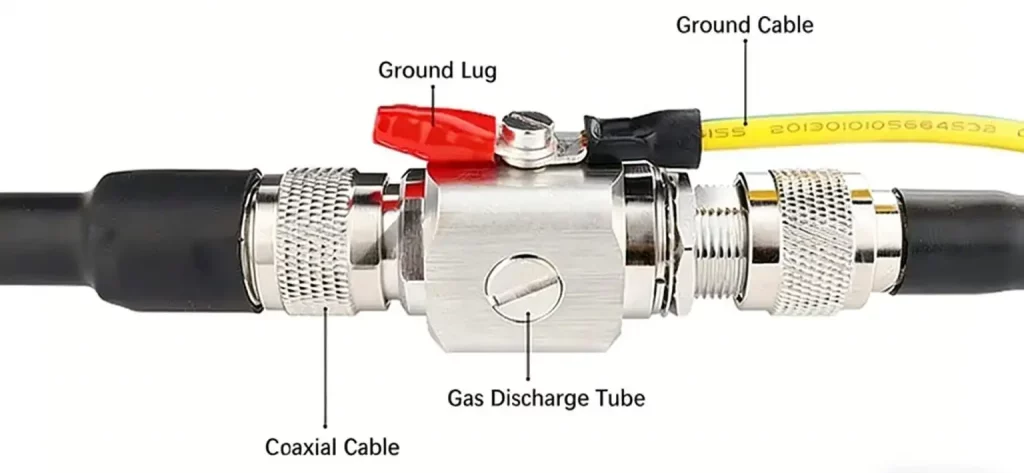
In modern telecommunications infrastructure, the antenna system is inherently exposed to atmospheric electrical activity. A coax lightning arrestor (also known as an RF surge protector) is an engineered passive component installed in-line with coaxial feedlines. Its primary function is to intercept high-voltage transients—caused by direct lightning strikes or, more commonly, induced electromagnetic pulses (EMP)—and safely shunt them to the grounding system before they can propagate into the base station cabinet.
Without reliable RF lightning arrestors, sensitive radio frequency equipment, such as transceivers, low-noise amplifiers (LNAs), and remote radio heads (RRHs), are vulnerable to catastrophic dielectric breakdown and component failure.
The surge diversion mechanism generally relies on one of two core technologies:
- Gas Discharge Tube (GDT): Features a sealed ceramic tube filled with an inert gas. Under normal operating RF voltages, it remains a high-impedance state, practically invisible to the RF signal. When a high-voltage surge occurs, the gas ionizes within nanoseconds, creating a near-short circuit that redirects the heavy surge energy to the ground. Why does this matter? GDTs offer broad frequency compatibility and can pass direct current (DC) voltage, which is essential for powering tower-mounted amplifiers (TMAs) or active antennas through the coaxial cable.
- Quarter-Wave Stub: Utilizes a carefully tuned internal physical short circuit. At the target RF center frequency, this physical short acts as an electrical open circuit, causing minimal insertion loss and maintaining optimal impedance. However, to low-frequency lightning surges, it behaves as a direct, low-impedance path to the ground. Why does this matter? This design provides superior multi-strike durability and extremely low residual voltage, ensuring maximum protection for high-value assets, though it is fundamentally narrow-band and blocks DC current.
Protecting your network with proper surge suppression minimizes costly hardware replacement and prevents critical network downtime. For standard or specialized grounding solutions, explore our engineered protection devices.
Deciphering IEC 61643-21: The Engineering Cornerstone of RF Surge Protection
When selecting an RF lightning arrestor, simply checking the connector type is insufficient. Professional-grade protection is validated against IEC 61643-21, the international standard for surge protective devices connected to telecommunications and signaling networks. This standard ensures that the device can withstand repeated surge events without compromising the integrity of the RF signal or the safety of the downstream equipment.
Compliance with IEC 61643-21 involves rigorous laboratory testing of several critical performance metrics:
- Impulse Durability (Category C2 & D1): This measures the arrestor’s ability to survive multiple high-energy strikes. For instance, Category C2 testing involves 10 applications of an 8/20 μs combination wave. A compliant coax lightning arrestor must maintain its protective characteristics after these events.
- Voltage Protection Level (
Up): This defines the maximum residual voltage that will reach your equipment during a surge. Why does this matter? If theUpexceeds the dielectric withstand voltage of your radio’s input stage, the arrestor is effectively useless. - Insertion Loss and Return Loss (VSWR): IEC 61643-21 compliant devices are tested to ensure that the internal protection components (like the GDT) do not introduce impedance mismatches. High-quality arrestors typically maintain an insertion loss of <0.1 dB and a VSWR of <1.2:1 across their operational frequency range.
| Performance Metric | Significance for Engineers |
|---|---|
| Nominal Discharge Current (In) | The peak current (8/20 μs pulse) the device can safely divert multiple times without failure. |
| Response Time (tA) | How quickly the GDT ionizes; essential for protecting sensitive high-speed semiconductors. |
| Spark-over Voltage | The precise voltage threshold at which the protection mechanism triggers to shunt energy. |
By specifying IEC 61643-21 surge protection, procurement managers can mitigate the risk of using “substandard” clones that might fail prematurely or, worse, fail to trigger during a real lightning event.
Engineering Note: No surge protector can guarantee 100% protection against a direct, catastrophic lightning strike, but compliance with IEC standards significantly reduces the probability of equipment failure.
Application-Specific Selection: Matching Interfaces to RF Infrastructure
Choosing the correct interface is not just about physical connectivity; it reflects the power handling and frequency requirements of your specific application.
N-Type Lightning Arrestors: The Standard for IoT, Helium, and LoRaWAN
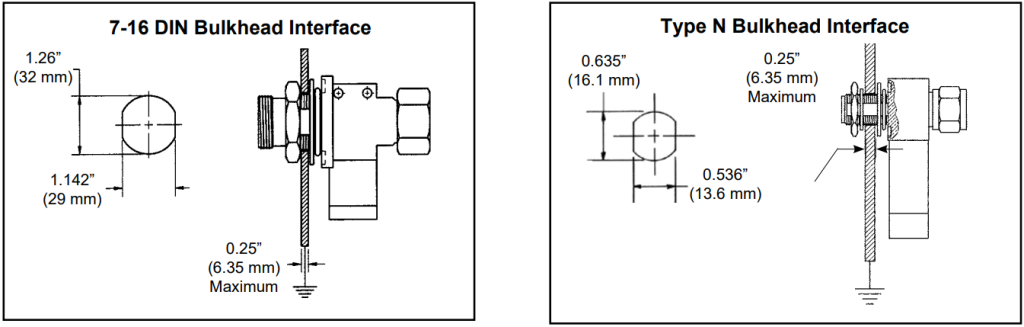
The N-type lightning arrestor is perhaps the most versatile component in the wireless industry. Due to its threaded coupling and robust weather resistance, it has become the de facto standard for the Helium miner community and LoRaWAN gateway deployments.
- Why it fits: These applications typically operate in the Sub-GHz range (e.g., 868 MHz or 915 MHz). N-type connectors offer excellent impedance matching (50 Ohms) and are physically strong enough to support outdoor antenna mounting.
- Pro-Tip for Helium/LoRaWAN: For a lightning protection for outdoor wireless bridge or IoT gateway, always install the arrestor as close to the equipment entry point as possible, ensuring a low-impedance ground path to a dedicated copper rod.
7/16 DIN Surge Arrestors: High-Power Solutions for Macro Cells
In the world of carrier-grade telecommunications, the 7/16 DIN Surge Arrestor is the primary choice for high-power macro base stations. As 5G networks densify, the need for components that can handle high peak power without generating interference is critical.
- PIM Performance: 7/16 DIN interfaces are engineered to minimize Passive Intermodulation (PIM). A low-PIM lightning arrestor ensures that the protection circuitry doesn’t create “noise” that could degrade the upload speeds of the entire cell site.
- Power Handling: These are designed for high-wattage deployments where smaller connectors like SMA or even N-type would risk thermal failure under continuous high-power transmission.
| Application | Recommended Interface | Key Engineering Requirement |
|---|---|---|
| Helium / LoRaWAN | N-Type (M/F) | Low insertion loss, IP67 weatherproofing for outdoor deployment. |
| Outdoor Wireless Bridge | N-Type or SMA | Compact footprint, critical for point-to-point link stability. |
| 5G/4G Macro Base Station | 7/16 DIN or 4.3-10 | Low PIM (<-160 dBc), high peak power handling capabilities. |
| Broadband Wireless (BWA) | N-Type / TNC | Flat frequency response up to 6GHz for high-speed data. |
Whether you are securing a community-driven IoT node or a multi-million dollar telecom site, selecting the right interface is the first step toward long-term reliability.
Performance in Extreme Environments and Broadband Networks
In mission-critical infrastructure, the electrical protective capability of an RF lightning arrestor is only half the story. The mechanical integrity and signal transparency of the device under harsh environmental conditions are equally vital for long-term site uptime.
Weatherproofing: The Criticality of an IP67 Rated RF Lightning Arrestor
For tower-mounted equipment, moisture is the silent enemy of RF performance. Ingress of water or even high humidity into a coaxial interface can cause impedance discontinuities, leading to high VSWR and permanent corrosion of the center conductor.
- IP67 Protection: A high-quality IP67 rated RF lightning arrestor features dual O-ring seals and precision-machined housings. This rating ensures the device is completely dust-tight and can withstand temporary immersion in water.
- Engineering Benefit: Utilizing IP67-rated components reduces the need for extensive weatherproofing tapes or heat-shrink tubing, simplifying installation and reducing the total cost of ownership (TCO) over the site’s lifecycle.
Maintaining Signal Integrity for Broadband Wireless Access (BWA)
As deployments transition to Broadband Wireless Access (BWA) and high-throughput point-to-point links, the “insertion loss budget” becomes incredibly tight. Every 0.1 dB matters when pushing the limits of QAM modulation schemes.
- Ultra-Low Insertion Loss: High-end arrestors are designed with compensated internal geometries to ensure an insertion loss of typically <0.1 dB across the entire spectrum (up to 6 GHz).
- Flat Frequency Response: For broadband systems, it is essential that the arrestor maintains a consistent VSWR across the operating band to avoid signal distortion.
When your network’s throughput and reliability are on the line, settling for generic protection is a risk. Ensure your components meet the rigorous demands of modern BWA deployments.
Troubleshooting and Installation Best Practices: Ensuring Long-Term Site Integrity
A high-performance coax lightning arrestor is only as effective as its installation. Even the most advanced IEC 61643-21 compliant device will fail to protect your equipment if the grounding path is compromised or if it is placed incorrectly within the signal chain.
Critical Installation Checklist
To ensure maximum suppression of transient surges, engineers should adhere to the following rigorous installation standards:
- Proximity to Entry Point: The arrestor must be installed as close as possible to the point where the coaxial cable enters the building or equipment cabinet. This prevents surge energy from radiating into nearby internal wiring.
- Low-Impedance Grounding: Use a heavy-gauge copper strap or wire (typically 6 AWG or larger) for the ground connection. The path to the primary ground bus bar should be as short and straight as possible; sharp bends in the ground wire create high inductance, which resists the fast-rising edge of a lightning strike.
- Weather Sealing: While an IP67 rated RF lightning arrestor is designed for moisture resistance, we recommend additional weather-proofing (such as butyl rubber tape) for the cable-to-connector junctions in high-salt or tropical environments.
Troubleshooting Common RF Issues
If you experience signal degradation after installing an arrestor, check the following:
- High VSWR: Ensure the connectors are torqued to the manufacturer’s specifications. A loose N-type or 7/16 DIN connection is a common cause of impedance mismatch.
- DC Continuity Check: If your system uses a Tower Mounted Amplifier (TMA), verify that you are using a GDT-type arrestor. A quarter-wave stub arrestor will show a DC short and block power to your active components.
- GDT Depletion: After a major storm, the gas within the discharge tube may eventually deplete. Many professional arrestors feature a replaceable GDT element. If signal loss or intermittent connectivity occurs, inspect the tube for signs of thermal stress or electrical arcing.
| Problem / Symptom | Potential Root Cause | Recommended Engineering Action |
|---|---|---|
| No Signal / Dead Link | Incorrect arrestor type (Quarter-wave stub blocking DC power). | Verify if active components (TMA/LNA) need DC. Replace with GDT-type if necessary. |
| Intermittent Signal Drop | Loose grounding nut or oxidized contact points. | Clean grounding terminals and re-torque all connections to manufacturer specifications. |
| Increased Noise Floor | GDT reached end-of-life or experienced thermal stress. | Inspect and replace the internal Gas Discharge Tube (GDT) element immediately. |
| High VSWR (>1.5:1) | Impedance mismatch due to loose N-type or 7/16 DIN coupling. | Check connector seating and ensure the arrestor supports the operational frequency band. |
Proper maintenance and precise installation are the final steps in securing your RF infrastructure. For detailed technical support or to source replacement GDT elements, contact our engineering team.
Recommended products
_695df4855c26a.jpg)
_695df4abd8c56.jpg)
_695df4b71612a.jpg)
_695df4c291ae9.jpg)
Frequently Asked Questions
Where is the best place to install a coax lightning arrestor?
The most effective location is at the "bulkhead" or the entry point of the building or equipment shelter. By installing the arrestor here and connecting it to the master ground bar, you ensure surge energy is diverted before entering the sensitive indoor environment.
Can I use a lightning arrestor with a system that requires DC power over the coax?
Yes, but you must select a Gas Discharge Tube (GDT) type arrestor. GDT models allow DC voltage (used to power TMAs or LNAs) to pass through the center conductor while still providing surge protection. Avoid "Quarter-Wave Stub" designs as they block DC.
How often should I replace the Gas Discharge Tube (GDT)?
GDTs are consumable components. We recommend inspection after any major lightning event. If you notice increased VSWR or physical darkening of the ceramic tube, replace it. In high-lightning areas, proactive replacement every 2-3 years is best practice.
Does an RF lightning arrestor affect my signal strength?
A high-quality, IEC 61643-21 compliant arrestor has negligible impact on your signal. Typical insertion loss is less than 0.1 dB. However, using a low-quality unit can cause significant signal reflection (High VSWR).
Is an N-type lightning arrestor compatible with Helium miners?
Yes, N-type is the industry standard for outdoor Helium/LoRaWAN setups due to its durability. Ensure you check whether you need Male-to-Female or Female-to-Female configurations to match your cable.
For further technical specifications or bulk procurement inquiries, please visit our technical resource center or [Contact Us]: [email protected].

Connectors & cable assemblies manufacturer.
Sharing insights on connectors and real-world applications.
Contact for datasheets, samples, or inquiries.
