
Introduction
Imagine you have just finished assembling a high-power radio transmitter. You are eager to test it, but connecting it directly to an antenna for testing is risky—it could cause interference with local regulations or broadcast unstable signals. More importantly, if the antenna isn’t perfectly tuned, you risk destroying your expensive Power Amplifier (PA) in milliseconds.
This is where the RF dummy load becomes the engineer’s best friend. Acting as a stand-in for your antenna, a dummy load allows for safe, controlled testing and troubleshooting.
In this guide, we will dive deep into the mechanics of the 50 ohm dummy load, explore the historical reasons behind the 50-ohm standard, and clarify the critical differences between a dummy load and a terminator RF.
What Is an RF Dummy Load?
At its core, an RF dummy load is a resistive component designed to absorb all the radio frequency energy coming from a transmitter and dissipate it as heat. In technical terms, it acts as a “sink” for RF energy.
How It Works
When testing a transmitter, the output must be connected to a load with a specific impedance (usually 50 ohms) to mimic a perfectly tuned antenna. If you were to transmit without any load (an “open” circuit) or with a short circuit, the energy would have nowhere to go.
Ideally, a dummy load is a pure resistor with zero reactance (inductance or capacitance). This ensures that it absorbs 100% of the signal power without reflecting any of it back to the source.
Key Functions
-
Simulation: It tricks the transmitter into thinking it is connected to an ideal antenna.
-
Dissipation: It converts electrical energy into thermal energy (heat).
-
Protection: It prevents high voltage standing waves (VSWR) from damaging transmitter components.
Why Is 50 Ohms the Most Common Impedance?
You might wonder, “Why 50 ohms? Why not 10, 60, or 100?” The answer lies in the history of coaxial cable development and a compromise between power handling and signal loss.
The Historical Trade-off
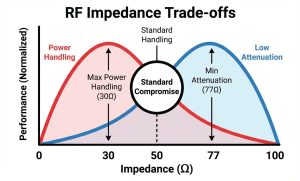
In the early days of RF engineering (circa 1930s), researchers experimented with different air-dielectric coaxial cables. They discovered two conflicting physical laws:
-
Maximum Power Handling: Occurs at approximately 30 Ohms.
-
Lowest Signal Attenuation (Loss): Occurs at approximately 77 Ohms
The Standard Compromise
A standard of 30 ohms would be great for transmitting massive power but would lose signal quickly over distance. A standard of 77 ohms would carry signals far but couldn’t handle high power voltages.
As documented in early literature from Bell Labs (1929), 50 Ohms was chosen as the arithmetic mean—a perfect compromise. It offers tolerable power handling capabilities while maintaining reasonably low signal loss. This is why the vast majority of RF dummy loads and testing equipment today are standardized to 50 ohms.
The Hidden Risk: What Happens Without a Dummy Load?
Failing to use a dummy load during testing is one of the most common causes of transmitter failure. To understand why, we need to talk about VSWR (Voltage Standing Wave Ratio).
When RF energy travels down a cable and hits a mismatch (like an open port or a broken antenna), it doesn’t just stop. It reflects back toward the source. This reflected wave collides with the forward wave, creating a “Standing Wave.”
The Consequences of Reflection:
-
Voltage Spikes: The combination of forward and reflected waves can create voltage peaks that exceed the breakdown voltage of the output transistors or tubes, causing immediate burnout.
-
Thermal Runaway: The reflected energy must be dissipated somewhere. Often, it dissipates as heat inside the final amplifier stage, leading to overheating.
-
Interference: If testing with a real antenna instead of a load, you may accidentally broadcast on emergency frequencies, violating FCC or local regulations.
Using a 50 ohm dummy load ensures a VSWR of 1:1 (or very close to it), meaning virtually all power is absorbed, and none is reflected.
RF Dummy Load vs. RF Terminator: Are They the Same?
In the industry, the terms “Dummy Load” and “Terminator RF” are often used interchangeably, but there is a nuance in their application, primarily related to power handling.
While they perform the same electrical function (terminating a line with a resistor), their physical design differs significantly.
Summary: If you are testing a 100W radio, you need a 50 ohm dummy load. If you are capping an unused port on a 4-way receiver splitter to prevent ghost signals, you need a terminator RF.
How to Select the Right 50 Ohm Dummy Load
Choosing the wrong load can be just as dangerous as using none at all. Here are the three critical factors to consider:
Power Rating (The 50% Rule)
Never choose a load rated exactly for your transmitter’s output. A good rule of thumb is to select a dummy load rated for at least 1.5x to 2x your transmitter’s average power.
-
Example: For a 50-watt transmitter, use a 100-watt dummy load. This ensures the resistor stays within safe thermal limits during prolonged testing.
Frequency Range
Not all resistors work at all frequencies. A load designed for HF (High Frequency) might behave like a capacitor at GHz frequencies, causing high VSWR. Ensure the load’s spec sheet confirms it is “non-inductive” up to your maximum operating frequency.
Connector Type
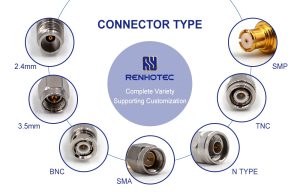
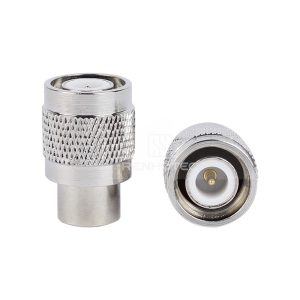
Using adapters adds insertion loss and can degrade VSWR. Always try to match the connector on the load (N-Type, SMA, TNC, 7/16 DIN) directly to your equipment.
FAQ
Q: Can I build my own dummy load using standard resistors?
A: For DC or Audio frequencies, yes. However, for RF, standard wire-wound resistors act like inductors (coils) and will not present a 50-ohm load at high frequencies. You must use specialized carbon or metal film non-inductive resistors.
Q: Is it normal for the dummy load to get hot?
A: Yes, absolutely. The purpose of the load is to convert electrical energy into heat. However, if it smells like burning plastic or is too hot to touch instantly, you may be exceeding its power rating.
Q: Can I use a 75 ohm load on a 50 ohm system?
A: It is not recommended. Connecting a 75-ohm load to a 50-ohm system creates a mismatch with a VSWR of 1.5:1. While this might be acceptable for some receiving equipment, it is not ideal for precision transmitter testing (ARRL Handbook, 2022).
Related Products
Contact Us
Find Your Precision RF Termination Solution
Selecting the right coaxial load is crucial for accurate testing, system protection, and ensuring signal integrity in RF applications. Whether you require standard 50-ohm loads for lab measurement and calibration, or high-power, low-VSWR loads for demanding telecommunications, broadcast, or aerospace systems, our engineering team has the expertise to meet your performance and reliability requirements.
Contact our RF component specialists at [email protected] to discuss your RF load specifications, request custom designs for unique power or frequency needs, and access our complete RF Catalog!

As an industry specialist at Renhotec Group, I have years of expertise in the field of electronic interconnection. Founded in 2008, Renhotec Group is a global leader in designing and manufacturing connectors, cables, and custom electronic components for a wide range of industries. We are committed to providing high-performance interconnect solutions, leveraging technical innovation and rigorous quality standards to empower global customers across industrial, RF, and EV sectors.
